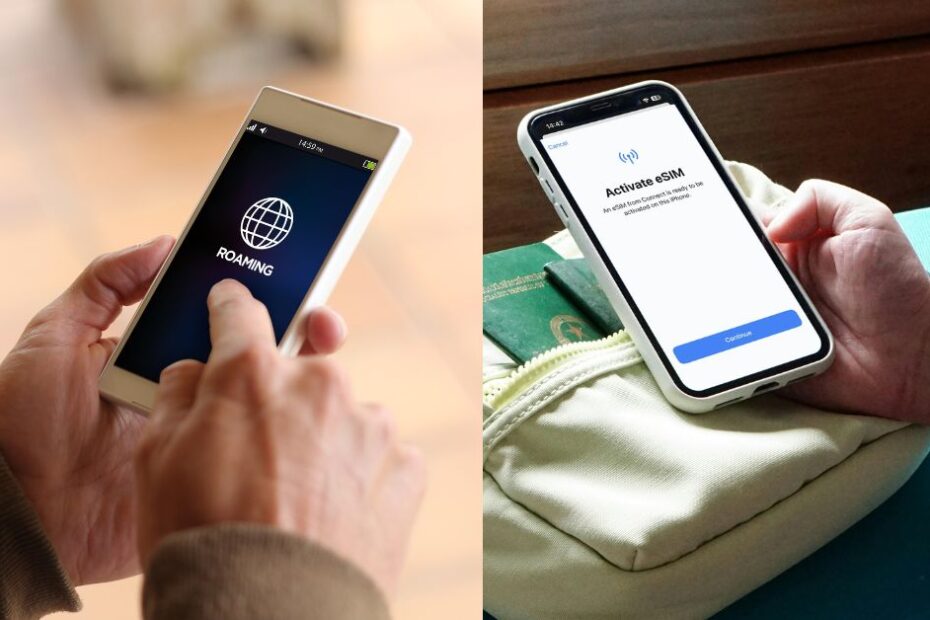
Detailed cost savings comparison of eSIMs versus traditional carrier data roaming fees. Traveling internationally used to mean bracing yourself for a massive phone bill when you returned home. Traditional cellular carriers have long charged high rates for international data usage, leading to the dreaded “bill shock.”
Today, travel eSIMs provide a competitive alternative, allowing you to bypass your carrier’s roaming fees entirely. This guide compares standard roaming packages with travel eSIMs to show exactly how much you can save on your next trip.
1. Introduction: The Reality of International Roaming Fees
Staying connected while traveling internationally is no longer an optional luxury; it is an absolute operational necessity. From checking live flight statuses, presenting mobile boarding passes and e-visas, to navigating public transit systems, ordering ride-shares, and checking hotel reservations, almost every phase of modern travel relies on a stable internet connection.
Unfortunately, using your home mobile carrier’s cellular connection abroad can quickly lead to financial headaches. Before eSIMs became mainstream, the media was filled with stories of travelers returning home to “bill shock”-monthly bills totaling thousands of dollars due to unexpected background data usage. While major networks have introduced international day passes to address this issue, these solutions are often expensive. They act as a flat daily tax of $10 to $15 per device, adding $100 to $150 to a single traveler’s budget for a 10-day trip. For families or small groups traveling together, these daily fees can easily add hundreds of dollars to the total trip cost. Travel eSIMs offer a digital-first alternative that bypasses the traditional carrier roaming infrastructure, giving you control over your connection and your budget.
2. How Traditional Carrier Roaming Works
When you cross an international border and keep your home SIM card active, your phone registers on a local partner network. This is called roaming. But behind this simple connection is a complex, multi-layered telecom infrastructure that explains why it is so expensive.
Because your home carrier does not own cellular towers or physical equipment in the destination country, they rely on reciprocal roaming agreements. Here is how your data is routed:
- The Handshake: Your phone connects to a foreign tower owned by a local carrier (e.g., Vodafone in Europe).
- The Route: The foreign network routes your internet requests all the way back to your home carrier’s core network in your home country (e.g., AT&T in the US) to verify your account status and apply content filters.
- The Bill: The foreign network measures your data usage and bills your home carrier at high wholesale roaming rates.
- The Markup: To cover these international transit costs, administrative overhead, and profit margins, your home carrier adds a substantial premium markup before charging your account.
These costs are ultimately passed on to you as daily international passes or astronomical per-megabyte usage charges on your monthly statement.
3. What Makes Travel eSIMs So Much Cheaper?
Travel eSIMs operate on a completely different business model that bypasses your home carrier’s expensive transit routes and high markups:
- Direct Local Sourcing: Travel eSIM providers function as Mobile Virtual Network Operators (MVNOs) or partners with international telecom wholesalers. They negotiate directly with local carriers to purchase massive blocks of cellular data at deep wholesale discounts.
- Local Data Routing: When you use a travel eSIM, your internet traffic is routed locally within the destination country or region rather than being sent back to your home country. This significantly reduces latency and lowers the transit costs associated with data transmission.
- No Administrative Middlemen: Because the entire transaction is digital-from purchase to delivery and profile configuration-there are no physical SIM card manufacturing, packaging, shipping, or retail store overhead costs.
- Prepaid Control: eSIM plans are prepaid, meaning you purchase a fixed data allowance (e.g., 5GB or 10GB) upfront. This structural design makes it impossible to run up surprise bills, as your data access automatically cuts off when you reach the limit unless you manually purchase a top-up.
4. The Daily Cost Comparison: Carrier Passes vs. eSIM Plans
Most major carriers in the US, UK, and Canada charge a flat daily rate for international day passes:
- Carrier Day Passes: These typically cost $10 to $15 per day (e.g., AT&T International Day Pass, Verizon TravelPass, Rogers Roam Like Home). For a 10-day trip, this adds up to $100 to $150 per device.
- Travel eSIM Plans: A typical destination-specific eSIM plan (e.g., 10GB of high-speed data valid for 30 days) often costs between $10 and $25 total.
Here is a daily rate comparison table:
| Data Option | Average Daily Cost | 10-Day Total Cost | Data Limit |
|---|---|---|---|
| AT&T / Verizon Pass | $10.00 / day | $100.00 | Uses home plan bucket |
| Rogers / Telus Pass | $12.00 to $15.00 / day | $120.00 to $150.00 | Uses home plan bucket |
| Travel eSIM Plan | $1.00 to $2.50 / day | $10.00 to $25.00 | Fixed (e.g., 10GB or Unlimited) |
5. Pay-As-You-Go Traps: The True Cost of Roaming per Megabyte
If you do not subscribe to an international day pass and leave your cellular roaming active, carriers will bill you at standard pay-as-you-go rates. These charges represent one of the biggest consumer traps in modern telecom:
Warning: Pay-as-you-go data roaming rates can reach $2.05 to $15.00 per Megabyte.
To understand how dangerous this is in practice, look at how typical smartphone activities translate to pay-as-you-go charges:
- Opening a Modern Web Page (approx. 5MB): Costs $10.25 to $75.00 in roaming fees.
- Streaming a 3-Minute Video in HD (approx. 60MB): Costs $123.00 to $900.00.
- Automatic Cloud Photo Upload (approx. 1GB/1000MB): Costs $2,050.00 to $15,000.00.
Since 1 Gigabyte (GB) contains 1,024 Megabytes (MB), background apps syncing in your pocket can generate immediate charges of hundreds of dollars before you even step foot outside the airport terminal. An eSIM completely eliminates this risk by operating on a strictly prepaid data bucket.
6. Real-World Case Study: A 10-Day Trip to Europe
To illustrate the actual cash differences, let’s look at a realistic case study of a traveler named Sarah spending 10 days exploring France and Italy. During her trip, Sarah uses data to post holiday pictures on Instagram, navigate using Google Maps, translate menus, and buy train tickets on the go.
- Option A (Standard Carrier Roaming Pass): Sarah keeps her primary home SIM card active and activates her carrier’s international pass at a flat fee of $10 per day.
- Daily Cost: $10.00.
- Total Expense: $10/day × 10 days = $100.00.
- The Inefficiency: On days three and seven, Sarah spends most of her time on free hotel Wi-Fi or traveling on trains, using minimal cellular data. However, because her phone is active, she is still charged the full $10 daily rate.
- Option B (Prepaid Regional Europe eSIM): Before leaving, Sarah purchases a regional Europe eSIM with a 10GB high-speed data allowance valid for 30 days. This single digital profile provides network coverage across both France and Italy.
- Total Expense: $18.00 flat price.
- The Efficiency: Sarah has 10GB of data to use at her own pace over the 10 days, with no daily fee pressure.
- Financial Outcome: Sarah saves $82.00 (an 82% savings) on mobile data. She can use these savings to pay for a nice dinner in Rome or museum tickets in Paris, while enjoying the same high-speed network coverage.
7. Real-World Case Study: A 14-Day Trip to Japan
Let’s look at another example: a solo traveler or a couple taking a 14-day vacation in Japan. Due to the complex train networks and Japanese-only signs, their daily data usage is high-averaging 1.2GB per day for transit schedules, camera translations, and staying connected during long train rides on the Shinkansen.
- Option A (Canadian Carrier International Pass): The traveler relies on their home carrier’s day pass, which bills at a premium rate of $15 per day.
- Daily Cost: $15.00.
- Total Expense: $15/day × 14 days = $210.00 for one device.
- Option B (Japan-Specific Travel eSIM): The traveler purchases a Japan-specific eSIM package loaded with 20GB of high-speed data, valid for 30 days.
- Total Expense: $26.00 flat price.
- The Data Buffer: 20GB is more than enough for their 14-day stay, giving them a comfortable daily allowance of roughly 1.4GB. Even with heavy map usage, they remain under their data cap and pay zero extra fees.
- Financial Outcome: The traveler saves $184.00 (an 87% savings). If traveling as a couple, using two eSIMs instead of two carrier passes increases the total savings to $368.00-enough to cover a night at a traditional Ryokan or multiple sushi dinners.
8. Multi-Country Travel: The Savings Multiply Across Borders
For travelers visiting multiple countries in a single trip (e.g., backpacking through Southeast Asia or taking a multi-city European vacation), eSIMs offer even greater savings and convenience.
- The Carrier Border-Crossing Penalty: Standard carriers charge you their daily roaming fee the moment you connect to any partner network. If you travel from London to Paris by train, your phone will register on a UK network in the morning and a French network in the afternoon. Some carriers will bill you for two separate daily passes in a single 24-hour window because your data was routed through two different international zones.
- The Regional eSIM Solution: You can purchase a regional eSIM plan (such as a Europe Regional, Asia Pacific, or Latin America plan) that covers 30 to 40 neighboring countries. The digital profile remains active on your phone, automatically switching to local carrier partners as you cross borders. There are no registration prompts, no connection interruptions, and zero border-crossing fees.
- Bypassing Local Bureaucracy: Purchasing physical SIM cards in every new country requires finding local kiosks, waiting in lines, exchanging currency, and registering your passport at each stop. A single regional eSIM handles the entire trip, saving you time and keeping your personal data secure.
9. Hidden Fees to Watch Out For with Traditional Roaming
Carrier day passes often come with strict conditions in the fine print that can lead to unexpected charges on your monthly bill:
- The Timezone Calculation Trap: Most carriers define a “day” using your home billing timezone rather than the timezone of your travel destination. For example, if your home timezone is New York (EST) and you land in Tokyo (JST) at 11:00 PM, using your phone for just 1 hour will trigger a full $10-$15 daily pass fee. At midnight New York time (which occurs shortly after in Japan), a second day’s fee is triggered, costing you $20-$30 for a brief period of connectivity.
- Automatic Background App Refresh: Even if your phone is locked in your pocket, background processes (such as email syncing, system widgets, or automatic app updates) will consume minor amounts of data. This tiny background network handshake instantly triggers your carrier’s full daily roaming fee.
- Strict Speed Throttling Caps: Many carrier day passes claim to offer “unlimited data,” but the fine print reveals that high-speed 4G/5G data is capped at 500MB or 2GB per day. Once you exceed this cap, your speed is throttled to 2G levels (usually 128kbps), rendering maps and taxi apps virtually unusable. Travel eSIMs, on the other hand, provide clear upfront data pools at consistent high speeds.
10. Additional Value: Beyond Direct Monetary Savings
While the direct cost savings of travel eSIMs are significant, they also offer key operational advantages that improve your travel experience:
- Zero Physical Risk and Hardware Wear: Swapping tiny plastic Nano-SIM cards while sitting in a cramped airplane seat or walking through a busy airport terminal is risky. It is easy to drop the card, damage the fragile SIM tray, or misplace your primary card. With an eSIM, the entire setup is digital, keeping your home physical SIM safely inside your phone.
- Seamless Dual-SIM Operations: By using an eSIM for international data, you can keep your home SIM active for calls and SMS. This allows you to receive security verification codes (SMS OTPs) from your bank, flight update alerts, and messages on your primary number at no cost, while routing all internet traffic through the cheap travel eSIM data connection.
- Instant, Flexible Top-Ups: If you run out of data during your trip, there is no need to find a local retail store or convenience shop. You can monitor your data usage in real time via the eSIM provider’s mobile app and buy a top-up package (e.g., adding 1GB or 3GB) in seconds with a few taps.
11. Frequently Asked Questions (FAQs)
Here are the answers to the most common questions about saving money with travel eSIMs:
No. Travel eSIMs are prepaid. You pay a one-time fee for a specific plan (e.g., 5GB for $15). Once your data bucket is empty or the plan expires, the connection simply stops unless you choose to buy a top-up. There are no automatic overage charges.
In some destinations, a local SIM card from a downtown store can be slightly cheaper. However, airport kiosks often charge premium tourist rates. eSIMs are highly competitive, save you time spent waiting in queues, and provide instant connectivity upon arrival.
No. As long as you disable data roaming on your home SIM line, your home carrier cannot charge you for mobile data. You only pay the eSIM provider for the data package you purchase.
12. Summary Checklist: Maximize Your Travel Data Savings
Follow this checklist to ensure you do not receive unexpected charges on your next trip:
- Before Travel: Buy and install your destination eSIM profile using home Wi-Fi.
- Home SIM Settings: Turn Data Roaming OFF on your home SIM profile.
- Astro Settings: Turn off cellular data switching to prevent automatic carrier switching.
- Preferred Data: Set your Travel eSIM as your default line for Cellular Data.
- Media Optimization: Turn off auto-downloads for photos and videos on messaging apps to conserve data.
- Monitoring: Use your eSIM provider’s app to track your data usage during your trip.